

Most product reviews fail for one simple reason: they read like a school report or a sales pitch. Readers don’t want either. They want a shortcut to a smart decision, with enough proof to feel safe.
A high-converting product review structure does the same job a good friend would do. It gives the headline answer fast, shows what’s good and what’s not, then helps the reader choose the next step with confidence. And yes, it can still be persuasive without being pushy.
If your goal is to replace your 9-to-5 income, you need reviews that earn trust first, then clicks.
Start with a clear framework (so readers don’t get lost)
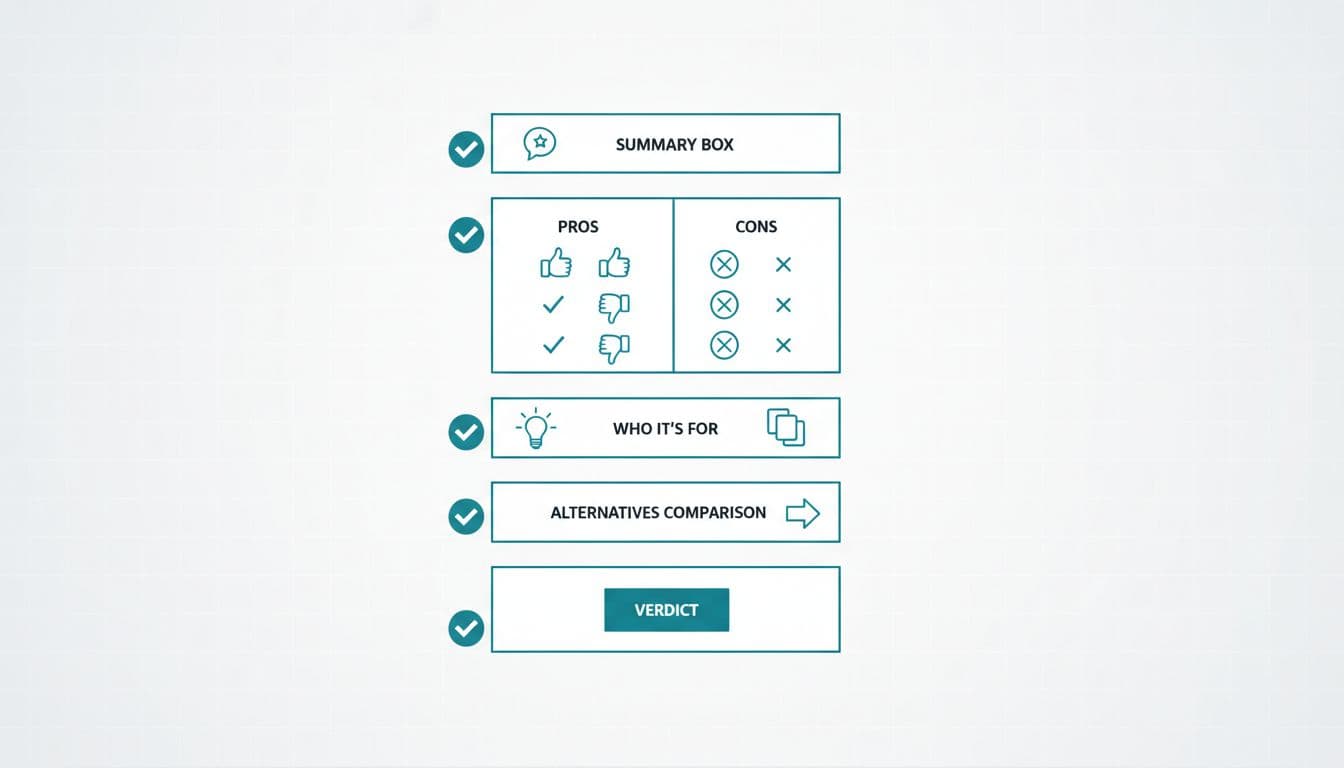
Think of your review like a guided store tour. If you force people to wander, they leave. If you show them the best aisle first, they stay.
A conversion-friendly structure usually looks like this:
1) Quick verdict box (above the fold)
Give the reader the “should I care?” answer in 10 seconds.
Include:
- Best for (one line)
- Not ideal for (one line)
- Your overall take (one sentence)
- A clear button-style link (your main call to action)
This is where you win the impatient readers without sacrificing honesty.
2) Problem first, product second
Don’t open with features. Open with the painful moment your reader already lives.
Examples:
- “You’re getting traffic, but no emails.”
- “You’ve tried three tools and still feel stuck.”
- “You don’t want another ‘course’ that’s really a pep talk.”
Then position the product as a possible solution, not a magic trick.
3) What you tested (and what you didn’t)
If you used it, say how. If you didn’t, say what you reviewed instead (docs, demos, community feedback, terms).
This line alone can separate you from the “I totally used it (I did not)” crowd.
For more examples of review layouts that focus on sales without looking spammy, see Authority Hacker’s product review guide.
Build trust signals that make clicks feel safe

People don’t buy when they’re unsure. They buy when risk feels managed.
Here are trust signals that raise conversions without turning your review into a courtroom:
Use a plain-language affiliate disclosure
Place it near the top, before links.
Example:
Affiliate disclosure: If you buy through my link, I may earn a commission at no extra cost to you.
That’s it. No drama. No tiny gray font. Readers respect it more than you think.
Add proof, not noise
Pick 2 to 4 proof elements that match your product:
Screenshots or photos: Show what the user will see.
Specific outcomes: Time saved, steps reduced, fewer tools needed.
Constraints: “This only works well if you already have X.”
Support experience: Response times and helpfulness, if you tested it.
If you’re building reviews on WordPress, WPBeginner’s affiliate review tips are a helpful reference for presentation and trust elements.
Write each section to answer one buying question
A strong structure works because each part answers a single question in the reader’s head. Keep it simple.
| Reader’s question | Section that should answer it |
|---|---|
| “Is this right for me?” | Who it’s for, who it’s not for |
| “What do I get?” | Features, what’s included |
| “Will it be hard?” | Setup, learning curve, time required |
| “What’s the catch?” | Cons, limits, extra costs |
| “What else is like this?” | Alternatives, comparisons |
| “What should I do now?” | Verdict and next step |
Pros and cons that don’t feel fake
A “no cons” review reads like a used-car ad in a tuxedo.
Good cons are:
- Real (not “too awesome”)
- Relevant to the buyer’s life
- Paired with who should avoid the product
One-liner rule: If a con doesn’t change someone’s decision, cut it.
Alternatives (yes, include them)
Alternatives reduce pressure, which increases trust. They also keep the reader on your page instead of bouncing to Google.
A clean approach:
- Alternative A: better for budget
- Alternative B: better for advanced users
- This product: best for your specific reader type
If you want more ideas on structuring affiliate-style reviews, Affiliate Booster’s guide to affiliate reviews has solid formatting examples.
Fill-in-the-blank product review template (copy, paste, publish)
Use this template as your default. It keeps your product review structure consistent, even on busy weeks.
Review Title: [Product Name] Review: Best for [Audience Goal], but not for [Dealbreaker]
Affiliate Disclosure: If you buy through my link, I may earn a commission at no extra cost to you.
Quick Verdict (3 lines):
- Best for: [who it’s best for]
- Not for: [who should skip it]
- Bottom line: [one-sentence verdict]
The problem it solves:
If you’re dealing with [pain point], this tool helps by [outcome].
What it is (plain English):
[Product] is a [type of product] that [main job].
What’s included:
- [feature or component 1]
- [feature or component 2]
- [feature or component 3]
How it works (your experience):
I used it for [task] over [time period]. The setup took [time]. The hardest part was [thing].
Pros (with context):
- [pro] because [why it matters]
- [pro] because [why it matters]
Cons (be honest):
- [con] so it’s a poor fit if you [scenario]
- [con] and you may need [workaround/cost]
Who it’s for:
Great fit if you want [goal] and you have [starting point].
Who should avoid it:
Skip it if you need [dealbreaker] or you hate [requirement].
Alternatives worth considering:
- [Alternative 1] if you care most about [priority]
- [Alternative 2] if you already have [condition]
Verdict and next step:
If your main goal is [goal], I’d [recommend/avoid] [Product]. Next step: [try/demo/buy link].
Mini review example (short, structured, and sales-friendly)
Tool: “Email List Starter” (example tool)
Affiliate Disclosure: If you buy through my link, I may earn a commission at no extra cost to you.
Quick Verdict:
- Best for: beginners who want to start collecting emails this week
- Not for: marketers who need deep automation and complex tagging
- Bottom line: simple setup, solid basics, but you’ll outgrow it if you scale fast
The problem it solves:
If you’re getting clicks but no leads, this gives you a quick way to turn visitors into subscribers.
What it is:
Email List Starter is a beginner email capture tool that lets you build forms, send basic follow-ups, and track sign-ups.
How it felt to use:
Setup took about 30 minutes for a basic form and one welcome email. The editor was straightforward. I didn’t have to wrestle five menus just to change a button color, a rare gift.
Pros:
- Fast setup, good when you’re juggling a job and a side hustle
- Clean templates that don’t scream “internet marketing”
- Basic reporting that shows what’s working
Cons:
- Limited automation, so behavior-based sequences are tough
- Fewer integrations, you may need a workaround if you use niche tools
Who it’s for:
Good fit if you’re starting affiliate marketing and your first goal is “get 100 subscribers.”
Alternatives:
If you need advanced automation, choose a more robust email platform. If you want a free starter, pick a tool with a stronger free tier.
Verdict and next step:
If you want a simple way to start building an email list, it’s a fair choice. Try it if your priority is speed and clarity, then upgrade later if your needs grow.
Conclusion: Convert with clarity, not pressure
A review that converts doesn’t “convince” readers. It helps them decide. Use a consistent product review structure, lead with the verdict, prove your points, and tell the truth about trade-offs.
Your next step is simple: pick one product you already know, use the template above, and publish a review that sounds like you. Trust builds faster when your review reads like help, not hype.

My Name Is Rafael Ferreras. I share practical tips, tools, and resources to help make building income online simpler and more approachable. I am a professional digital marketer with over 14 years of experience in the industry. My expertise is in email marketing and boosting conversions with bridge pages. I write about affiliate marketing and traffic generation.