

Quitting your 9-to-5 with affiliate income sounds simple until rent shows up with its hands out. The goal isn’t to “escape work.” It’s to replace a paycheck with a system that pays you even on the days you don’t feel like being inspirational.
This affiliate marketing plan is a practical 12-month path built around numbers, habits, and risk control. It assumes you’re starting as a beginner, working nights and weekends, and you want a clean off-ramp, not a cliff jump.
Start with the boring math (it’s the part that keeps you safe)
Before month 1, define what “full-time” means in your real life.
Most people need a target that covers:
- Core bills (housing, food, utilities, transport)
- Health insurance and taxes (often the surprise guest at this party)
- A buffer for slow months
A solid starting target is 70 percent of your take-home pay for 3 straight months, plus cash reserves. Why 70 percent? Because your expenses might drop (commute, lunches), but your risk goes up.
If you bring home $4,000 a month, a smart “ready to leave” target is:
- $2,800 per month net affiliate profit for 3 months
- Plus runway (we’ll calculate it next)
Budget, runway, and a simple break-even calculation
Affiliate businesses don’t need a fancy office. They do need consistent publishing, tracking, and a way to capture emails. Here’s a realistic monthly budget for a beginner who wants progress without lighting money on fire.
| Item | Typical monthly cost | Notes |
|---|---|---|
| Domain + hosting | $15 to $35 | Starter plans are fine |
| Email marketing tool | $0 to $50 | Many start free, scale later |
| Keyword and SEO tool | $0 to $30 | Optional early on |
| Link tracking/shortener | $0 to $20 | Helpful, not required day one |
| Content help (optional) | $0 to $200 | Editing, images, outlines |
| Paid traffic testing (optional) | $0 to $300 | Only after you can convert |
A common “lean but serious” budget is $75 to $150 per month.
Runway calculation (so you don’t panic-sell your laptop)
Runway is how many months you can live if income dips.
Runway (months) = Cash savings ÷ (Monthly personal expenses + business costs − reliable income)
Example:
- Savings: $12,000
- Personal expenses: $3,200/month
- Business costs: $150/month
- Reliable affiliate profit (3-month average): $1,200/month
Runway = 12,000 ÷ (3,200 + 150 − 1,200) = 12,000 ÷ 2,150 = 5.5 months
Aim for 6 months runway if you can. Three months is workable, but it feels like biking downhill with a loose helmet strap.
The 12-month affiliate marketing plan (what to do, month by month)
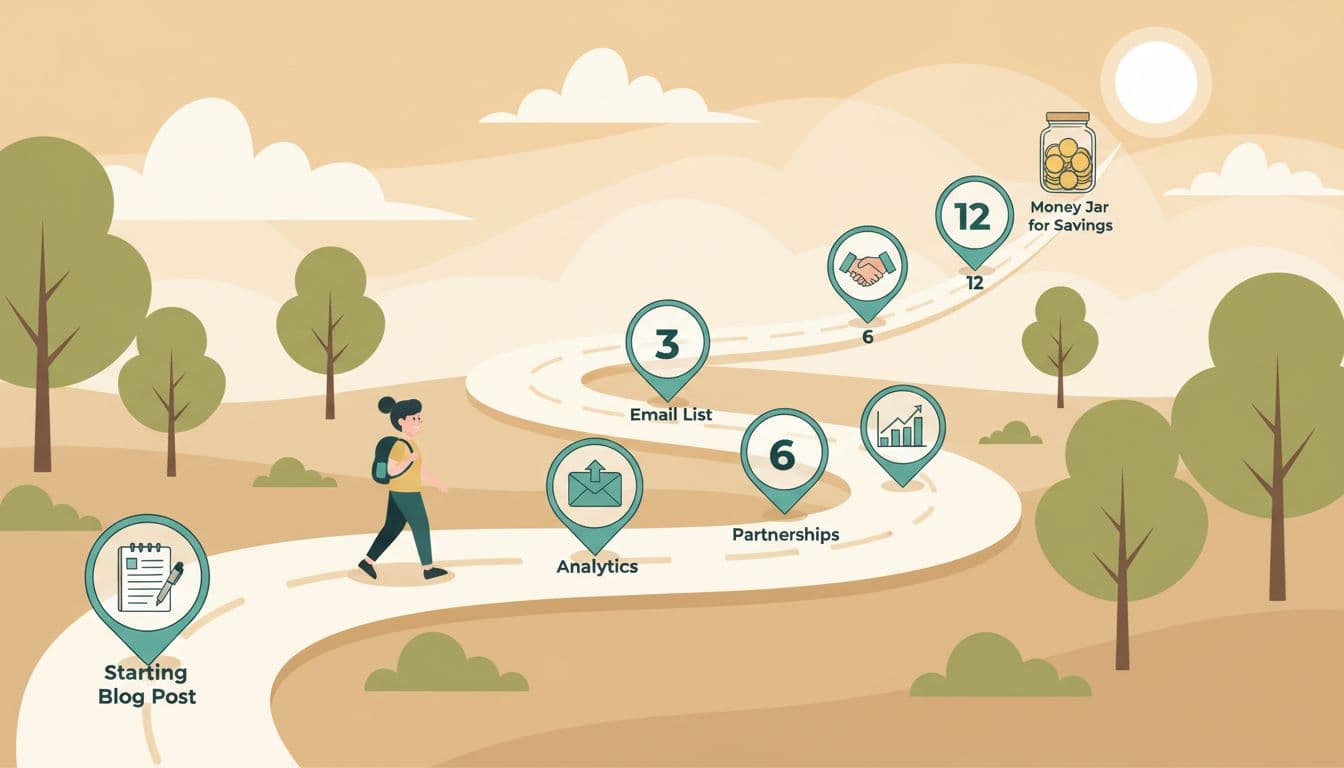
Think of the year like building a small house. Months 1 to 3 are the foundation. Months 4 to 9 are framing and wiring. Months 10 to 12 are inspection and making it livable.
Months 1 to 3: Pick a lane and publish like it’s your second job
Goal: Build trust and create your first set of “entry pages.”
Focus:
- Choose one niche you can write about weekly for a year (tools, hobbies, personal finance, home business, career skills).
- Pick affiliate programs you can stand behind. If you need ideas, skim a current list of networks and platforms, then choose two to start with: Shopify’s affiliate networks overview.
- Publish 8 to 12 helpful articles (not sales pages). Each should solve one problem.
Minimum content mix:
- 4 “how-to” guides
- 2 comparisons (A vs B)
- 2 beginner glossaries or checklists
- 1 honest review (pros, cons, who it’s for)
Compliance now, not later: add clear disclosures near links. If you want plain-English clarity on what “clear and conspicuous” means, read FTC affiliate marketing legal requirements.
Months 4 to 6: Add email, improve conversion, and stop guessing
Goal: Turn readers into subscribers, then subscribers into clicks.
Focus:
- Create 1 simple lead magnet (a checklist, short guide, or email course).
- Set up 5 to 7 welcome emails (help-first, not hype-first).
- Update your best 5 posts with better intros, clearer CTAs, and a few internal “next steps” links within your site (once you have enough pages).
Simple conversion target:
- 1 percent of visitors join your list
- 3 to 8 percent of subscribers click to an offer over time
Track basics:
- Which pages bring traffic
- Which pages get email sign-ups
- Which pages drive affiliate clicks
Months 7 to 9: Grow traffic without betting your life on one source
Goal: Diversify traffic and build relationships with brands and creators.
Traffic channels to add (pick two):
- SEO (keep publishing, refresh old posts)
- YouTube (one simple tutorial per week)
- Pinterest (if your niche fits)
- Short-form video (if you can stay consistent)
Partnership actions:
- Reach out to 2 partners per week (podcast hosts, newsletter owners, tool companies).
- Negotiate bonuses or higher commissions once you have proof.
Disclosure still matters on every platform. This breakdown of what disclosures should look like across channels is useful: Disclosure rules for affiliate links under FTC guidelines.
Months 10 to 12: Optimize, systemize, and build your exit ramp
Goal: Turn random wins into repeatable income.
Focus:
- Refresh your top 10 posts (new screenshots, updated pricing notes, better FAQs).
- Create 3 “money pages” that link out to your best offers (comparison, best-of list, start-here guide).
- Build a basic monthly reporting habit: traffic, email growth, EPC (earnings per click), and net profit.
At this stage, many beginners see something like:
- 10,000 monthly sessions
- 1 percent email opt-in rate (100 new subscribers)
- 2 to 5 percent click-to-offer rate
- $0.20 to $1.50 EPC depending on niche and offer
That can be $200 to $1,500 a month. Not glamorous, but it’s proof. Proof is what scales.
Weekly execution system (so your plan doesn’t become “vibes”)
Here’s a weekly schedule you can run with a 9-to-5.
| Day | Time (minutes) | Focus |
|---|---|---|
| Monday | 45 | Keyword research + outline |
| Tuesday | 60 | Draft section 1 and 2 |
| Wednesday | 60 | Draft section 3 + add examples |
| Thursday | 45 | Edit + add affiliate links + disclosure |
| Friday | 30 | Publish + share once |
| Saturday | 60 | Create 1 email + update 1 old post |
| Sunday | 30 | Analytics check + next week plan |
Content brief template (copy and reuse)
- Post goal: What problem gets solved?
- Reader: Beginner, buyer, or comparer?
- Primary question: The exact thing they’re trying to figure out
- Key points: 3 to 6 bullets you must cover
- Proof: Personal test, screenshots, quotes, or data
- CTA: Email sign-up or product next step
- Disclosure placement: Above first affiliate link
Outreach email template (short and polite)
- Subject: Quick idea for (their audience/topic)
- Hi (Name), I’m (Name). I publish practical guides on (topic).
- I’m putting together a resource on (specific problem) and I’m featuring tools people actually use.
- Do you have an affiliate program, partner kit, or a best link to share?
- If it’s a fit, I’ll include it with a clear disclosure and send you the link when it’s live.
- Thanks, (Name)
Quit-criteria checklist (don’t resign on a good Tuesday)
Use this checklist before you leave your job:
- You have 3 months in a row of affiliate profit at or above your target.
- You have at least 4 to 6 months runway in cash.
- No single traffic source drives more than 70 percent of your clicks.
- You can point to 10 pages that earn consistently (not one lucky post).
- You have a weekly work routine you can keep without burning out.
- Your disclosures are in place and easy to spot. If you want a deeper compliance rundown, this guide is thorough: FTC affiliate disclosure compliance guide.
Common pitfalls that slow people down (and how to avoid them)
Thin content that says nothing: If your post could be swapped with any other blog’s name, it won’t rank or convert. Add real examples, steps, and “who this is for.”
Over-reliance on one offer: Programs change terms. Build around problems, not products, and keep at least two strong offers per category.
Ignoring disclosures: Hidden disclosures don’t just risk trouble, they also kill trust. Put them near the first affiliate link, in plain language.
Chasing every platform: Pick two traffic sources, not five. Consistency beats busy.
Conclusion
Leaving a 9-to-5 with affiliate income isn’t magic, it’s math plus repetition. Build assets for 12 months, track what works, and protect your runway like it’s your favorite snack.
If you follow this affiliate marketing plan with steady effort, you’ll know exactly when you’re ready to go full-time, and you won’t need a motivational poster to do it.

My Name Is Rafael Ferreras. I share practical tips, tools, and resources to help make building income online simpler and more approachable. I am a professional digital marketer with over 14 years of experience in the industry. My expertise is in email marketing and boosting conversions with bridge pages. I write about affiliate marketing and traffic generation.




3 thoughts on “From 9-to-5 to Full-Time: A 12-Month Affiliate Marketing Plan That’s Actually Doable”
Comments are closed.