

Most people don’t fail online because they “can’t do business.” They fail because they build first and ask questions later. Weeks go by, money leaks out, and the only clear signal is a growing dislike of their laptop.
Niche validation flips that order. You test whether strangers will care, click, and pay before you sink time into a full site, product, or funnel. It’s less romantic than “follow your passion,” but it’s also cheaper.
This playbook is built for 2026 reality: attention is expensive, privacy rules are tighter, and your gut feeling still doesn’t count as data.
What niche validation is (and what it’s not)
Niche validation is a set of small experiments that answer one question: Will a defined group of people take a measurable action for a clear offer?
It’s not:
- Reading 37 Reddit threads and calling it “research.”
- Asking friends if they “like the idea” (they will, because they like you).
- Spending three months perfecting a website theme.
Validation is about behavior, not opinions. Clicks, signups, replies, preorders, deposits. If it didn’t require effort, money, or risk from the customer, treat it like entertainment.
If you need help choosing a starting niche, Shopify’s guide is a solid overview of how niches form around demand and positioning: How to find your niche (2026 guide).
Start with a falsifiable niche hypothesis
A “niche” isn’t just a topic. For niche validation, you want a short, testable hypothesis:
Audience + painful job-to-do + offer + price range + acquisition channel.
Example:
“New real estate agents who can’t keep up with leads will join a $49/month follow-up template library, found via Instagram Reels and paid search.”
Make it falsifiable with numbers:
- “If we can’t get X% CTR, the hook is weak.”
- “If leads cost more than $Y, margins won’t work.”
- “If fewer than Z% pre-buy, the offer isn’t urgent.”
This keeps you from “pivoting” every hour, which is just procrastination wearing a lab coat.
The fast validation funnel (idea to decision)
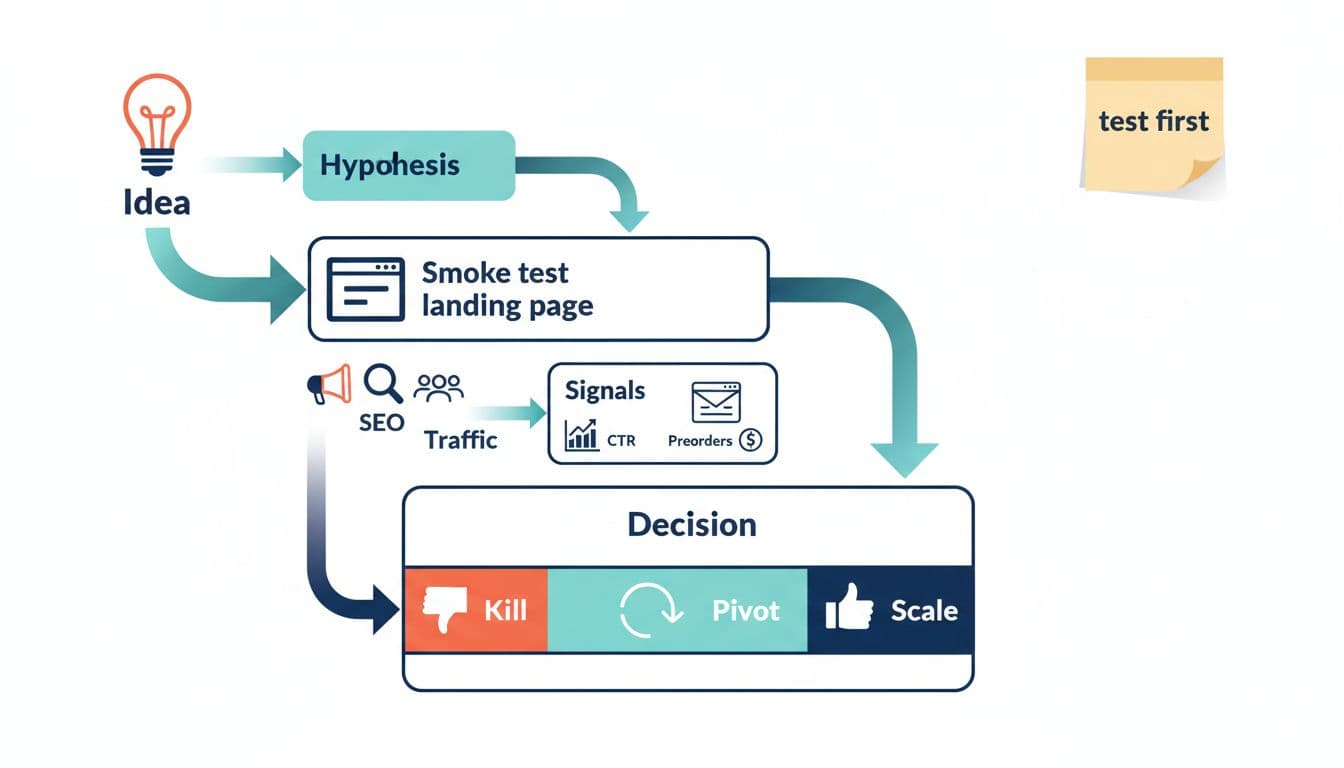
Think of validation like a narrow funnel. Each step should cost a little, teach a lot, and reduce uncertainty.
Step 1: Smoke test landing page
One page is enough:
- A clear promise (outcome, not features)
- Who it’s for (one sentence)
- Proof or credibility (even if it’s “I’ll build this with you”)
- One action (waitlist, call booking, preorder)
Step 2: Put paid or earned traffic behind it
Pick one channel you can control this week:
- Paid ads with small budgets
- Short-form content with a single CTA
- Community posts where your audience already hangs out
- Direct outreach (yes, it works, no, it’s not fun)
Step 3: Measure signals and decide
Your job is to make a decision, not to keep “testing” forever. In 2026, attention is the scarce asset, and endless testing is just slow motion quitting.
For a data-driven approach to idea signals (including audience building while validating), ValidatorAI has a practical overview: how to validate new ideas in 2026.
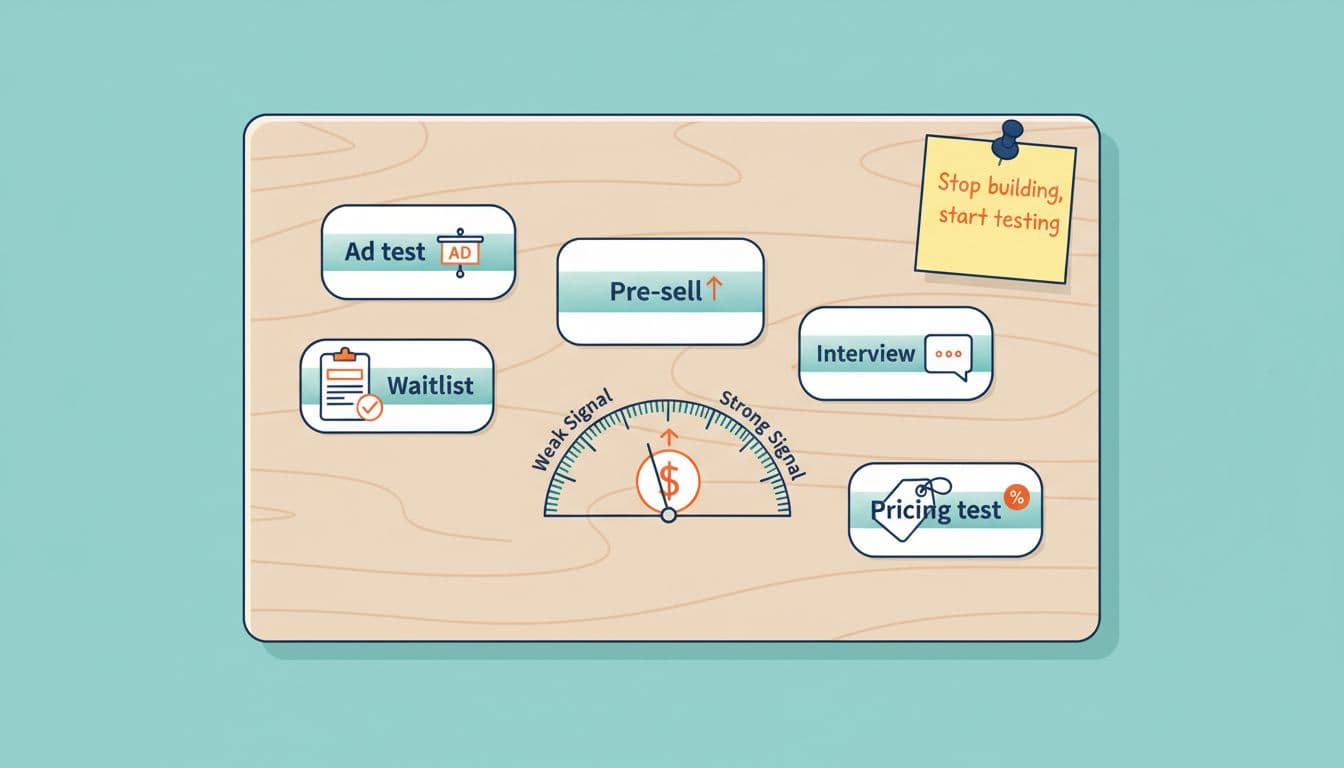
Pick the right validation method (speed vs signal)
Not all tests are equal. Some are fast but fuzzy, others are slower but close to revenue truth.
| Validation method | Typical time | Typical cash cost | Signal strength | Best for |
|---|---|---|---|---|
| Keyword and competitor scan | 1 to 3 hours | $0 to $50 | Low to medium | Early filtering, language people use |
| 10 to 15 problem interviews | 2 to 5 days | $0 | Medium | Pain clarity, offer angles |
| Smoke test landing page + waitlist | 1 day | $0 to $50 | Medium | Message-market fit, lead intent |
| Paid ad click test (to landing page) | 2 to 4 hours + 24 hours run | $50 to $200 | Medium to high | Demand check with fast feedback |
| Pre-sell (deposit or full payment) | 2 to 7 days | $0 to $200 | High | Real purchase intent, pricing |
| Concierge MVP (manual delivery) | 1 to 2 weeks | $0 to $200 | High | Retention and willingness to pay |
A good rule: use at least one method that requires effort or money from the customer (pre-sell, booked call, deposit). That’s where fantasies go to die, which is healthy.
If you want more “pain point sourced from real chatter” inspiration, BigIdeasDB shows how data can surface needs people complain about in public: SaaS ideas backed by pain points. You don’t need to build SaaS to use the approach.
Success criteria: the numbers that call the shot
You need thresholds before you run traffic, or you’ll rationalize anything. Use these as starting points, then adjust for your market and price.
Sample criteria for a cold traffic smoke test
- Ad CTR (cold): aim for 1.0% to 2.5%+ on simple static ads. Below 0.8% often means the hook misses.
- Landing page conversion to email: 20% to 40% is a strong sign for a clear pain and simple offer.
- Cost per lead (CPL): compare to what you can earn per buyer. If your target commission is $100, a $5 to $15 lead may work, a $40 lead usually won’t (unless closing rates are great).
- Booked call rate (from leads): 3% to 8% can be healthy for higher-ticket offers.
- Pre-sell rate (from leads): 1% to 5% is meaningful, especially if the traffic is cold.
Decision thresholds (kill, pivot, scale)
- Kill: Low CTR and low conversion, plus interviews show weak pain.
- Pivot: CTR is okay but conversion is weak (message mismatch), or conversion is okay but CPL is too high (channel mismatch).
- Scale: CTR and conversion are strong, CPL fits unit math, and at least a few people take a high-intent action (deposit, call, preorder).
A 72-hour niche validation sprint (copy this checklist)
Run this like an operator, not a poet.
- Write one niche hypothesis (audience, pain, offer, channel, price)
- Draft 3 hooks (headlines) using the audience’s own words
- Build a one-page smoke test (single CTA, no extra pages)
- Set up tracking (page views, CTA clicks, conversions)
- Launch one traffic source (ads, community post, short video, or outreach)
- Spend a fixed test budget (example: $100) or fixed effort (example: 30 DMs)
- Log results after 24 hours (CTR, conversion rate, CPL)
- Do 5 quick interviews with leads or responders (15 minutes each)
- Run a pre-sell ask (deposit, paid pilot, or “buy now, deliver in 14 days”)
- Decide: kill, pivot message, pivot channel, or scale budget
If this feels “too simple,” good. Simple is what ships. Complex is what sits in drafts.
Privacy-friendly analytics and clean measurement
In 2026, you can still measure what matters without turning your site into a surveillance project.
Consider privacy-friendly analytics tools such as Plausible, Fathom, or Matomo (self-hosted option). They focus on aggregate insights and reduce cookie headaches.
Keep your setup tight:
- Track events that map to decisions (CTA click, form submit, checkout start).
- Use UTM tags so you can tie results to each test.
- Store only what you need. You’re validating a niche, not building a government database.
Conclusion
Niche validation is how you stop gambling with months of your life. Write a clear hypothesis, run one or two fast tests, and hold yourself to real thresholds. When the numbers say “no,” take the win and move on.
Do the sprint, pick your next action, and let real data do the arguing. Your future self, the one who quit the 9 to 5, will appreciate the receipts.

My Name Is Rafael Ferreras. I share practical tips, tools, and resources to help make building income online simpler and more approachable. I am a professional digital marketer with over 14 years of experience in the industry. My expertise is in email marketing and boosting conversions with bridge pages. I write about affiliate marketing and traffic generation.