

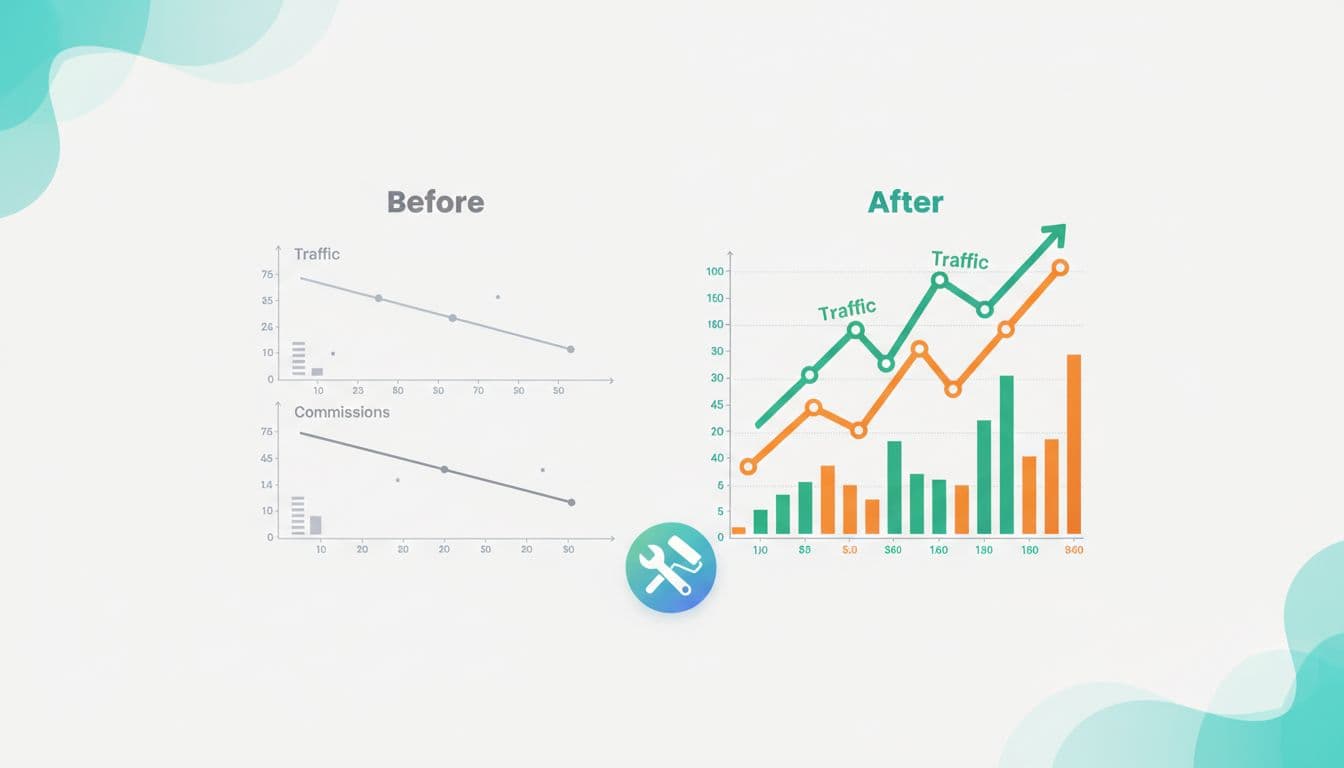
If you’ve been publishing affiliate posts for a while, you probably have a few “sleeping employees” on your site. They used to bring clicks, now they mostly bring nostalgia.
A focused affiliate content refresh wakes those posts up without you writing ten brand-new articles from scratch. The goal is simple: update 10 existing posts in 30 days, improve rankings and clicks, and give readers a clearer path to the products you recommend (without turning your site into a billboard).
Here’s a practical, repeatable system you can run every month.
Why refreshing old affiliate posts can pay faster than writing new ones
New posts start at zero. Refreshed posts usually don’t. They already have some combination of age, backlinks, impressions, and history with Google. When you update the content, you’re not “starting over,” you’re improving an asset that’s already on the field.
A refresh also helps conversion. Most affiliate posts drift over time: screenshots get old, features change, pricing changes, competitors pop up, and your call-to-action ends up buried under three paragraphs of “what is affiliate marketing.”
If you want a broad look at what typically moves the needle during updates, this content refresh guide for rankings and traffic is a helpful reference point.
The mindset shift that makes this work
Think of your content like a rental property. New content is buying a new house. Refreshing is repainting, fixing the leaky faucet, and raising the rent because the place is nicer now.
Your job in the next 30 days is to:
- pick 10 posts with real potential,
- run the same refresh checklist on each,
- track a small set of KPIs so you know what improved (and what didn’t).
Pick the 10 posts that are most likely to earn more
Don’t refresh posts at random. Pick posts that already show signs of life.
Use Google Search Console (free) and your affiliate dashboard to find posts that have impressions but low clicks, or clicks but weak earnings.
A simple scoring method (no spreadsheets required, but allowed)
Give each old post a score from 0–2 in each category, then refresh the top 10.
| Signal | 0 points | 1 point | 2 points |
|---|---|---|---|
| Search impressions | Low | Medium | High |
| Current ranking | Not in top 30 | Positions 11–30 | Positions 4–10 |
| Affiliate intent | Low | Mixed | Strong |
| Link health | Many broken/outdated | Some issues | Mostly clean |
| Earnings history | None | Some | Proven |
If you’re still building the bigger picture, it helps to map your refresh work into a longer plan, like this Step-by-Step Affiliate Plan for Beginners. Refreshing works best when your site has a clear path from “helpful post” to “money page.”
Quick pre-refresh checklist (per post)
Keep it tight:
- Confirm the product still exists and the affiliate program is active.
- Identify the main “job” of the post (review, comparison, tutorial).
- Note the top 3 queries the post is getting impressions for.
- Pull your current metrics (so you can compare later).
The 30-day schedule to refresh 10 affiliate posts (without burning out)
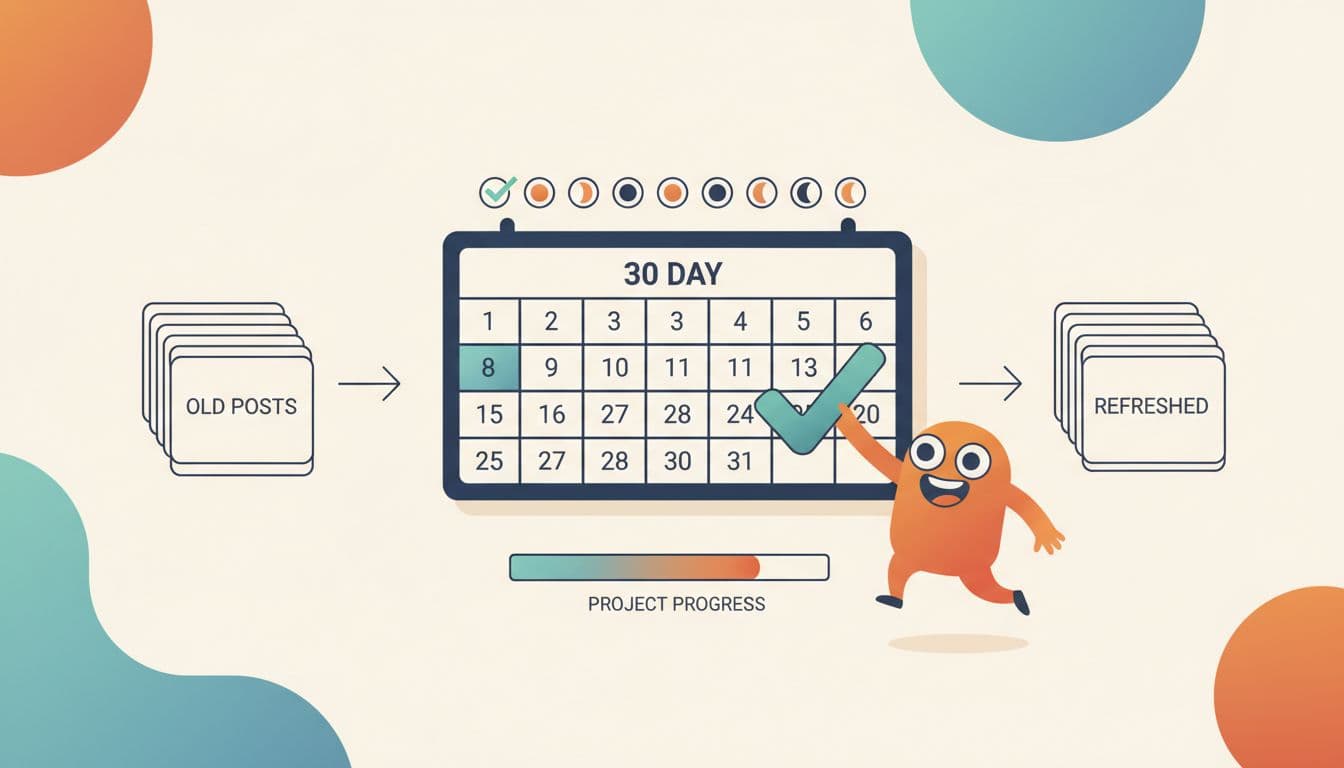
You’re updating 10 posts, not rewriting your entire site. The trick is batching.
The weekly cadence (simple, repeatable)
| Week | Focus | Output |
|---|---|---|
| Week 1 | Choose posts, set benchmarks, refresh templates | List of 10, baseline metrics, refreshed layout blocks |
| Week 2 | Refresh posts 1–3 | 3 updated posts published |
| Week 3 | Refresh posts 4–7 | 4 updated posts published |
| Week 4 | Refresh posts 8–10 + clean up internal linking | 3 updated posts, internal links updated, final QA |
A day-by-day flow that stays realistic
- Days 1–3: Pick your 10 posts, record baseline KPIs, collect competitor notes.
- Days 4–20: Refresh 2–3 posts per week. Aim for one post every 2–3 days.
- Days 21–26: Add internal links, build 1–2 comparison tables, improve CTAs site-wide.
- Days 27–30: Final checks (mobile, speed, broken links), submit updated URLs in Search Console, and log results.
If you’re promoting a mix of offers, match your updates to your commission strategy. A post pushing a higher-priced offer needs more trust and proof. This breakdown on choosing between high- and low-ticket products helps you set the right expectations for conversions.
The affiliate content refresh checklist (quick wins vs deeper rewrites)
Quick wins (30–60 minutes per post)
These are the “new paint” fixes that often help fast:
- Rewrite the intro so it matches what the searcher wants in the first 3–5 lines.
- Add a clear recommendation box near the top (“Best for beginners,” “Best budget pick”).
- Update pricing language to avoid being wrong (use “current price” and link to the source).
- Fix broken affiliate links and update outdated landing pages.
- Improve CTA placement (one early, one mid-post, one near the end).
A practical list of update ideas is also in Pretty Links’ post on simple blog update ideas for affiliate content, especially if your older posts are missing basic structure.
Deeper rewrites (90–150 minutes per post)
Use these when the post is ranking but not converting, or when competitors are clearly better:
- Add a comparison table (features, who it’s for, pricing approach).
- Expand missing sections: setup steps, downsides, alternatives, FAQs.
- Replace thin “benefits” with real proof: a short example, result, or screenshot (current).
- Tighten the “next step” path: link to your best related post, then the offer.
Before/after example (intro fix)
Before: “In this article, we’ll cover everything you need to know about email tools…”
After: “If you want to start affiliate marketing, you need an email tool that’s easy, affordable, and won’t break after 200 subscribers. Here’s the one I’d pick first, plus two alternatives.”
KPIs to track for 30 days (keep it boring, keep it honest)
| KPI | What it tells you | Where to check |
|---|---|---|
| Rankings (avg position) | Visibility trend | Google Search Console |
| CTR | Snippet and title match search intent | Google Search Console |
| Conversion rate | Page persuades the right reader | Affiliate dashboard or tracking |
| EPC (earnings per click) | Click quality and offer fit | Affiliate dashboard |
Want an extra “reality metric”? Track affiliate link CTR per post. If traffic rises but clicks don’t, the page is informational, not persuasive.
Compliance and trust (don’t skip this part)

Add an FTC disclosure near the first affiliate link, in plain words. Don’t hide it in the footer like a confession.
For a plain-English rundown, see Termly’s FTC affiliate disclosure explanation and this overview of FTC legal requirements for affiliate marketing.
A simple conversion path (so refreshed posts actually earn)
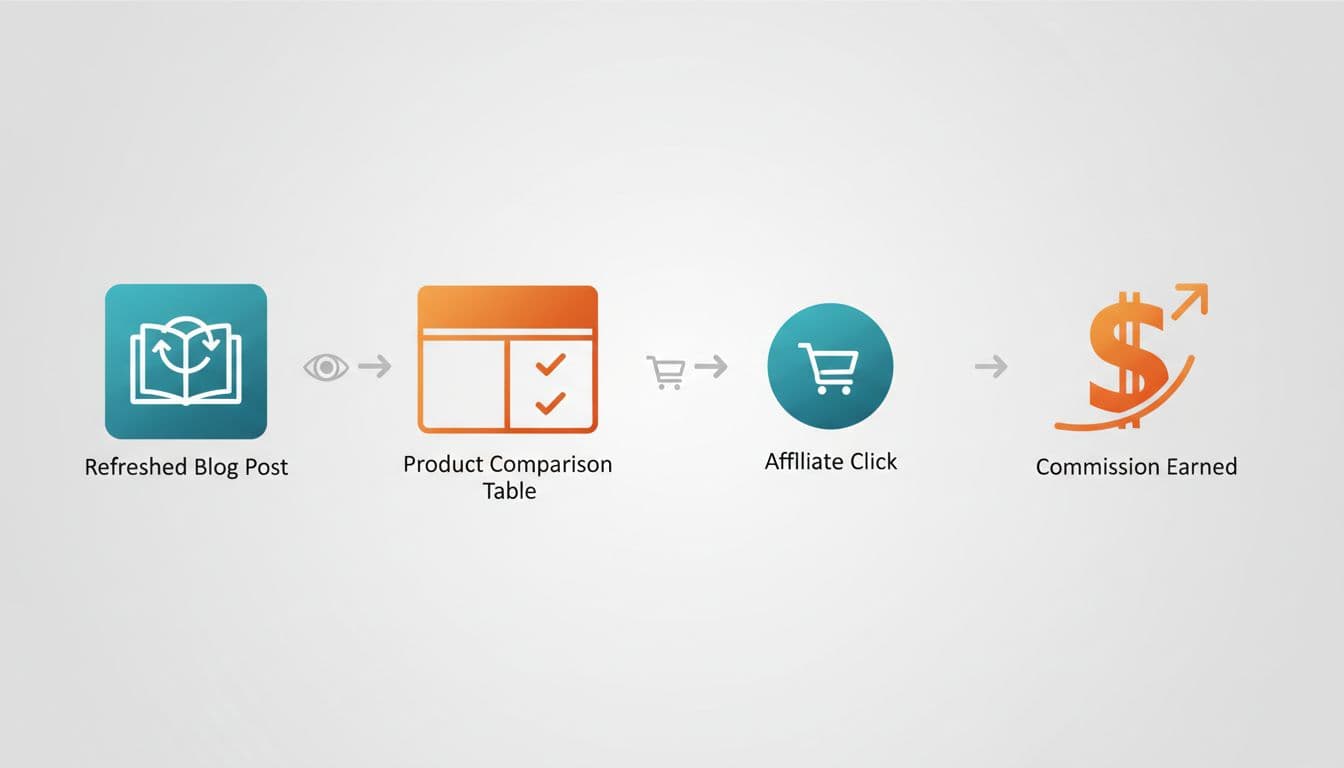
A refreshed post should guide readers like a good tour guide: friendly, clear, and not wandering off mid-sentence.
Use this flow:
- Answer the query fast (reduce pogo-sticking).
- Show options (best pick, runner-up, budget).
- Add proof and specifics (who it’s for, trade-offs).
- Send the click with a clear CTA.
Tools that help without making life complicated:
- Free: Google Search Console, GA4, Google Sheets, a broken link checker.
- Paid (optional): an SEO suite (Ahrefs or Semrush), a link manager/tracker plugin, and a writing editor if you need speed.
Conclusion
Refreshing old posts isn’t glamorous, but it’s effective. A disciplined affiliate content refresh system turns “old content” into working assets again, and it does it without adding 10 more drafts to your guilt pile. Pick the right posts, follow the same checklist, track CTR, rankings, conversion rate, and EPC, then repeat next month. The only thing better than new content is old content that still pays. Click here to subscribe to my mailing list to keep receiving new updates for making money online.

My Name Is Rafael Ferreras. I share practical tips, tools, and resources to help make building income online simpler and more approachable. I am a professional digital marketer with over 14 years of experience in the industry. My expertise is in email marketing and boosting conversions with bridge pages. I write about affiliate marketing and traffic generation.