
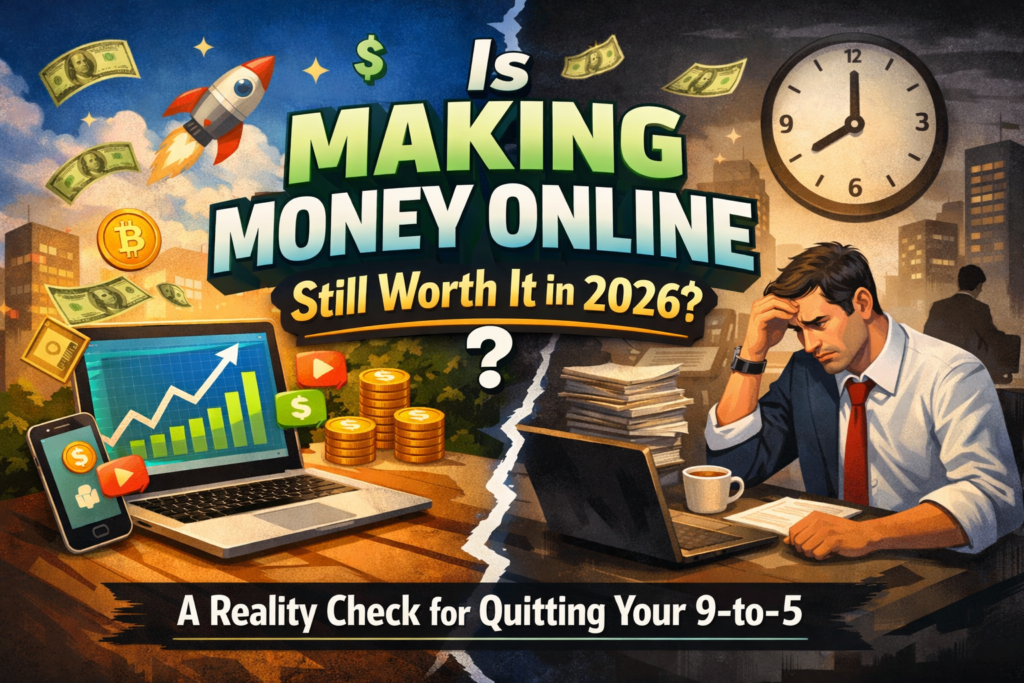
If you’re staring at your calendar in January 2026 and thinking, “I can’t do this job for another decade,” you’re not alone. The idea of making money online through a side hustle still pulls hard, because it promises control over your career, not just cash.
But the internet isn’t a vending machine. It’s a marketplace. And in 2026, that marketplace pays well, punishes laziness fast, and rewards people who build skills, systems, and trust.
This brief gives you a clear standard: what’s still worth doing to generate extra income, what’s getting harder, what to avoid, and how to decide if this path fits your time, budget, and risk tolerance.
The 2026 reality check: what’s evergreen vs what changes fast
 Photo by RDNE Stock project
Evergreen (stable advantages)
Demand doesn’t go away. People still pay for outcomes: saving time, making money, getting healthier, reducing stress, learning a skill.
Distribution compounds. Email lists, search traffic, and repeat buyers on online platforms still beat “post and hope.”
Proof sells. Results, reviews, demos, and transparent process win, even with small audiences.
Likely to change (plan for volatility)
Platforms rotate winners. What works on TikTok this quarter, like promising a flexible schedule, may stall next quarter. Expect policy shifts, reach swings, and sudden account reviews.
AI raises the baseline. Average content is cheaper to produce, so average content gets ignored. Quality, originality, and a real point of view matter more.
Compliance tightens. Ads, claims, and affiliate disclosures get more scrutiny, especially in finance, health, and income niches.
If you want quitting power for your side hustle, you need assets you control (site, list, customer relationships), not just attention you rent.
What still pays in 2026 (and what it usually takes)
Forget “best method.” Choose a model that matches your skills and patience.
Affiliate marketing (best for builders, not gamblers)
You earn commissions by recommending tools, programs, or products. The work is content, trust, and traffic in affiliate marketing.
- Typical ramp: 3 to 12 months to consistent commissions if you publish weekly on your YouTube channel or blog and build an email list.
- Why it still works: Businesses still want performance-based customers, and credible educators still convert.
- What’s changing: More brands demand higher-quality content and cleaner tracking. Expect more emphasis on first-party data and strong niches. See the 2026 trend direction in The Future of Affiliate Marketing: Trends To Watch in 2026.
Fit check: you can write, teach, or review honestly, and you can stick to a plan when results start slow.
If you want to check my affiliate program that I recommend, Click here.
Freelancing and consulting (fastest path to cash flow)
You sell freelance work: content writing, social media management, virtual assistant services, design, video editing, ads management, automation setup, tutoring, bookkeeping, or online tutoring. Popular freelance work options include content writing gigs, social media management tasks, and virtual assistant roles.
- Typical ramp: 2 to 6 weeks to first paid work if you pitch daily and keep a simple offer.
- Income range: wide, but more controllable than “content-only” models because you can set a rate and close clients.
- Tradeoff: you’re still trading time for money, at least early.
Fit check: you want income speed, you can talk to people, and you can deliver on deadlines.
Digital products (high margin, high standards)
Templates, courses, paid communities, ebooks, paid newsletters, mini-tools. Sell digital products through an Etsy shop or your own site; an Etsy shop is ideal for easy distribution.
- Typical ramp: 2 to 4 months to launch something decent, longer to dial in.
- Works best when: you already help people with a repeatable outcome (even a small one).
- Risk: weak positioning gets ignored, and refunds spike if you overpromise.
Fit check: you can teach clearly, and you’re willing to refine based on feedback.
E-commerce and print-on-demand (real upside, more moving parts)
You sell physical goods through marketplaces or your own store.
- Published early-stage range: many new stores land around $1,000 to $10,000 per month in extra income, with stronger stores often reaching higher after years of optimization (inventory, ads, retention).
- Reality: support tickets, suppliers, shipping, returns, and ad costs are part of the job.
Fit check: you like operations, you can test products, and you can handle customer service without melting down.
Creator income and live streaming (high ceiling, uneven results)
Ads, sponsorships, memberships, tips, and product sales. Live streaming continues to grow, with recent market projections pointing to strong annual expansion into 2030. Build momentum with a YouTube channel for better reach.
- Typical ramp: 6 to 18 months for meaningful income from this side hustle unless you already have an audience.
- Big risk: platform dependence.
Fit check: you can ship content relentlessly and stay consistent without instant applause.
The “is it worth it” scoring rubric (use this before you commit)
Score yourself 1 to 5 in each category. Total it. Use this to evaluate earning opportunities before you commit. Then pick a model among these earning opportunities that matches your score, not your fantasy.
Factor1 (Low)3 (Medium)5 (High)Time available<5 hrs/week7 to 10 hrs/week15+ hrs/weekCapital to invest$0 to $100$200 to $500$1,000+Risk tolerancehate uncertaintycan tolerate swingscomfortable testing and failingSkills today (online platform)beginnerone marketable skillstrong skill set + proofPatience runway0 to 2 months3 to 6 months9 to 12+ months
How to interpret your score
- 20 to 25: build assets (affiliate, content, products). You can play the long game.
- 14 to 19: hybrid path (freelance for cash flow, build affiliate or product on the side).
- 5 to 13: start with freelancing, part-time work, or a single paid skill as a side hustle. Don’t start with ads or inventory.
The execution checklist (simple, strict, and effective)
First 30 days: set the foundation
Pick one lane (affiliate, freelance, product, ecom). Start the application process. No stacking.
Define one customer you understand, and one painful problem you can solve.
Ship proof: 6 to 10 pieces of useful content, like practice test tutorials, or 3 strong portfolio samples showing practice test proficiency. Proof beats hype.
Set a weekly scorecard: hours worked, application process completions, outputs shipped, leads generated, sales calls, revenue.
Days 31 to 90: install traction mechanics
Build a basic funnel: one lead magnet, one email sequence, one offer.
Publish on one primary channel (blog or YouTube), optimized for mobile device, and one support channel (short-form or email) accessible on mobile device.
Do outreach if you need income now. Ten pitches a day beats waiting for an algorithm.
Review monthly: double down on what converts, delete what doesn’t.
Scam filters for 2026 (non-negotiable)
Caution: money-making opportunity scams and online employment scams
If it promises “guaranteed income,” “secret automation,” or “done-for-you profits” without clear work, assume it’s a trap, as these are hallmarks of online employment scams. Use the FTC’s guidance on Money-Making Opportunity Scams as your baseline checklist, perform a background check on the platform or partners, and insist on secure payments through PayPal before you pay anyone to avoid being scammed.
Caution: fake proof is getting smarter
AI-generated testimonials, fake screenshots, and paid comments are cheap now. Demand verifiable case studies, a thorough background check on any potential partners, refund terms in writing with PayPal as a secure verification standard, and a clear description of the work required.
Rule: if the business model is unclear, the real product is you.
Using AI ethically in 2026 (faster output, zero plagiarism)
Tools like ChatGPT can increase speed, but they can’t replace responsibility. Use ChatGPT like a junior assistant, not a ghostwriter you hide behind.
Use AI for
- Outlines, topic clustering, and editing for clarity with ChatGPT.
- Drafting email subject lines, ad angles, and content repurposing using ChatGPT.
- Checklists, summaries, and first-pass research questions.
Do not use AI for
- Copying other people’s work, “rewriting” paid courses, or scraping content with ChatGPT.
- Fake reviews, fake earnings claims, or fake endorsements.
Hold yourself to a publishable standard: accurate, original, and tested. If you want a clean framework for doing this right, read How To Do Ethical Content Creation in an AI World.
Conclusion: the 2026 answer, with conditions
Yes, making money online is still worth it in 2026 if you treat making money online like a real business and stop chasing shortcuts. Pick one model, build proof, control your traffic and list, and protect yourself from scams and platform risk to set up passive income. The quit-your-job outcome comes from consistency and compounding that passive income, not one viral week. Decide your side hustle lane, set your 90-day scorecard for extra income, and execute.
Recommended next steps (choose your scenario)
Scenario A: You need to make money fast (0 to 60 days).
Start microtasking to make money fast with quick gigs, then freelance with one clear offer, pitch daily, and build affiliate content on weekends.
Scenario B: You want to replace your 9-to-5 within 12 months.
Run a hybrid: client work for cash flow, supplement with online surveys and testing websites for extra income, plus one asset channel (blog or YouTube) feeding an email list and affiliate offers.
Scenario C: You have 10 to 15 hours a week and patience.
Go all-in on content plus affiliate marketing via an online platform, publish weekly, build your list from day one, track conversions like a hawk.
Scenario D: You have capital and like operations.
Test selling used clothes as a low-barrier entry to quickly hit payment thresholds, expand to e-commerce or print-on-demand with strict budgets, clear product research, gather customer feedback on operations, handle customer service and returns while monitoring payment thresholds and customer feedback.

My Name Is Rafael Ferreras. I share practical tips, tools, and resources to help make building income online simpler and more approachable. I am a professional digital marketer with over 14 years of experience in the industry. My expertise is in email marketing and boosting conversions with bridge pages. I write about affiliate marketing and traffic generation.




1 thought on “Is Making Money Online Still Worth It in 2026? (A Reality Check for Quitting Your 9-to-5)”