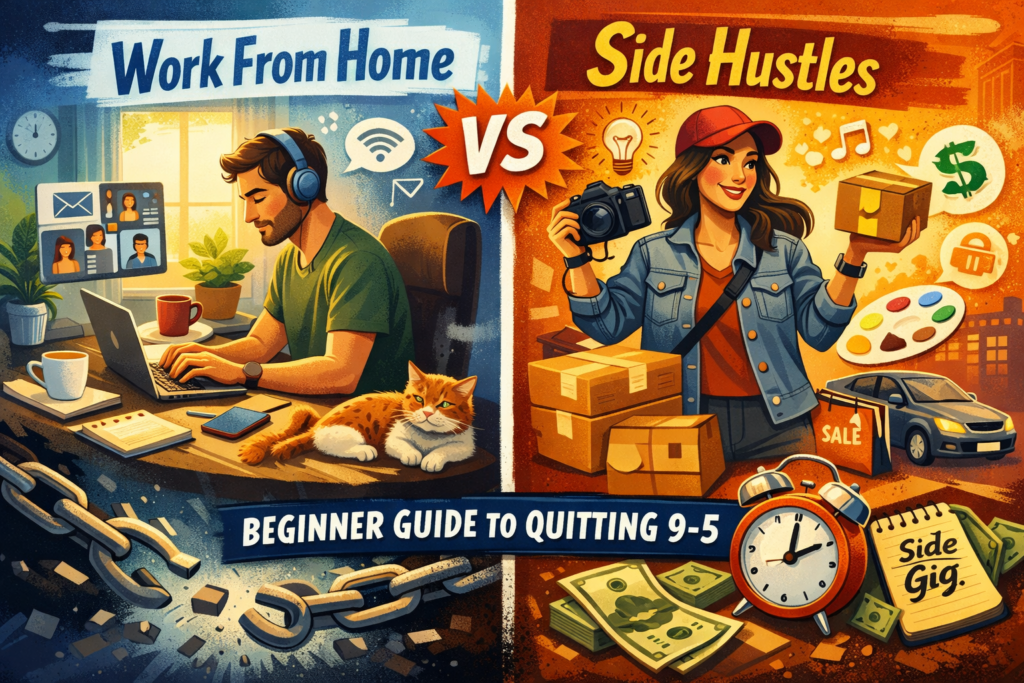
If you want out of a 9-to-5, you’re usually chasing two things at once: income you can count on and freedom you can feel. That’s the hard part for beginners. Most “make money online” advice skips the boring details like stability, taxes, and how long it takes to get paid.
Two paths show up again and again: a work-from-home job (a remote role with a clear pay structure) and a side hustle (a small business or gig you run on your terms). Both can work, and both can go wrong when you pick the wrong one for your life.
This guide compares work from home vs side hustles using beginner-friendly criteria: stability, speed to first dollar, skills, risk, and long-term upside. You’ll also get a simple decision guide and a realistic 30-day starter plan.
Work from home vs Side Hustles: What each one really is
Before picking a direction, it helps to define what you’re actually signing up for.
A work-from-home job is a role where a company pays you a wage or salary to do set tasks. You’re typically an employee or a contractor, and your job has rules, tools, and expectations.
A side hustle is a small income project you run yourself. You pick the offer, set the price, and find customers. You also handle the messy parts like marketing, customer service, and tracking income for taxes.
Here are beginner-friendly examples of each:
- Work-from-home jobs: customer support, chat support, virtual assistant for a company, appointment setter, basic admin work.
- Side hustles: freelance writing or design, reselling online, local services (pet sitting, cleaning), content plus affiliate marketing, simple digital products.
Many people end up doing both. The difference is what you make your primary focus first.
Work-from-home jobs explained (steady pay, set role, sometimes benefits)
Work-from-home roles usually trade freedom for predictability. You know what your tasks are, when you’re working, and how you’ll get paid.
Remote can mean different things:
- Fully remote: you work from home all the time.
- Hybrid: you work from home some days and go in on others.
- Remote-first: the company is built for remote work, even if some people choose an office.
Beginners often like remote jobs for three reasons:
Predictable paycheck: You can plan bills around it.
Training and structure: You’re not guessing your next step.
Clear hiring process: Apply, interview, onboard, start.
The downside is that you’re still trading time for money, and you’re working inside someone else’s system.
Side hustles explained (you control the offer, the hours, and the risk)
Side hustles are closer to building a tiny business. You decide what you sell, who you serve, and how you deliver it. That control is the point, but it comes with responsibility.
Expect income to be uneven at first. One week you might make $0, the next you might land a great client. You also handle things a job normally covers for you:
- Tools and software
- Customer conversations
- Deadlines and quality
- Pricing and packages
- Basic bookkeeping and taxes
Side hustles can start simple, then grow into something real. Freelancing can become an agency. A reselling hobby can become a storefront. A content site can become a steady stream of affiliate commissions.
Beginner scorecard: Which path fits your life, budget, and goals?
A good beginner choice isn’t about what sounds exciting. It’s about what you can stick with when life gets busy.
One trend matters in January 2026: remote work is still a big part of the labor market. Several roundups report about 22 percent of the US workforce working fully remote, with hybrid work also common (see Remote Work Statistics 2026 for a compiled snapshot). That means remote roles are not rare, but competition is real.
Side hustles also remain popular, but reliable 2026 numbers on “average weekly side hustle hours” vary widely by survey and definition. For beginners, your personal reality matters more than a headline. Can you give it 5 hours a week, consistently, for 3 months? That’s the question that predicts progress.
Here’s a quick scorecard to help you decide.
| Beginner factor | Work-from-home job | Side hustle |
|---|---|---|
| Income stability | Higher, predictable pay | Lower at first, can grow |
| Speed to first dollar | Often faster after hiring | Can be fast, but inconsistent |
| Schedule control | Medium, depends on role | High, you set it |
| Skills needed to start | Resume, interviews, basic tools | Offer, pricing, selling, delivery |
| Upfront costs | Low to medium | Low to medium (varies by hustle) |
| Risk type | Job loss, layoffs, hours cut | Slow sales, refunds, dry spells |
| Long-term upside | Limited by role and hours | Higher if you build an asset |
Now let’s break these down in plain language.
Income you can count on vs income that can grow
If your bills are tight, stability is not a “nice to have.” It’s oxygen.
A remote job tends to win on reliability. You work X hours, you get paid X dollars. That makes budgeting possible, and it lowers stress.
A side hustle can beat a job long-term, but it usually starts smaller and less steady. The early stage often looks like this:
- You spend time learning and setting up.
- You make a few offers.
- You get a “maybe” or a “not now.”
- Then you get your first yes.
A simple way to think about it: stability first when you need relief, upside later when you have breathing room.
Time, flexibility, and burnout risk
Remote work can give you back time, but only if you protect it. If you roll from your laptop straight into scrolling, the “extra time” disappears.
A side hustle gives more control, but it can also creep into every evening. When you’re the boss, it’s easy to work all the time.
If you’re choosing based on flexibility, look at your energy, not just your calendar:
- If you’re drained after work, a demanding side hustle may stall.
- If you’re bored and restless, a side hustle can feel energizing.
- If you have caregiving duties, predictable shifts may beat a hustle that requires constant outreach.
Remote work also isn’t immune to pressure. Some companies track activity or pack your day with meetings. If you’re weighing remote roles, pay attention to the culture, not just the job title.
For more context on how companies are handling remote and office expectations, this overview of return-to-office statistics and trends helps explain why some remote roles are stable and others are changing.
Skills and learning curve (what you must learn first)
Beginners sometimes pick the “easier” path and end up stuck because they chose something that doesn’t match how they work.
Minimum skills for many work-from-home jobs:
- A clean resume and basic interview answers
- Reliable communication (email, chat, video calls)
- Comfort with common tools (Google Docs, spreadsheets, ticket systems)
Minimum skills for most side hustles:
- A clear offer (what you do, who it’s for, what it costs)
- Basic selling (reach out, follow up, ask for the sale)
- A simple delivery system (how you fulfill consistently)
A quick “good fit” guide:
- You’ll like a remote job if you prefer structure, clear tasks, and steady routines.
- You’ll like a side hustle if you enjoy problem-solving, talking to customers, and improving something over time.
If you’re not sure, pick based on what you’ll do consistently for 30 days, not what looks exciting on social media.
Costs, tools, and risk (money you might spend to start)
Most beginners don’t fail because they’re lazy. They fail because they overspend or overcomplicate.
Work-from-home job costs tend to be predictable:
- Reliable internet
- A quiet space, even if it’s just a corner
- Headset and basic computer setup
Side hustle costs depend on the hustle:
- Freelancing can start with almost nothing.
- Reselling might require small inventory.
- A content-based hustle might need a domain and basic tools.
Risk also looks different.
Remote job risk: you can lose the role, hours can be cut, and you may depend on one payer.
Side hustle risk: sales can be slow, customers can disappear, and you must manage your own tax planning.
If you do side income, learn the basics of self-employment taxes and recordkeeping in your country. In the US, the IRS self-employed section is the starting point, but don’t wing it. Keep clean records from day one.
What’s better for beginners who want to quit their 9-to-5? A simple decision guide
Beginners don’t need a perfect choice. They need a choice that fits their risk level and gets momentum.
Use these decision rules.
Choose a work-from-home job if you need stability first
Pick a remote job first if most of these are true:
- Your bills are tight and you can’t handle uneven income.
- You need benefits or a predictable schedule.
- You want training and clear expectations.
- You do well with set tasks and deadlines.
- You need proof of income for rent, loans, or childcare.
- You want a faster path to consistent pay.
Beginner-friendly remote categories to consider:
- Customer support (phone, email, or chat)
- Admin assistant roles
- Virtual assistant roles for companies (not just solo creators)
- Appointment setting or scheduling
- Moderation or community support (varies by platform)
A quick caution: be careful with “data entry” listings. Some are real, many are low pay, and scams are common. If a job promises huge pay for simple tasks, it’s usually trouble.
Choose a side hustle if you want control, skills, and higher upside
Pick a side hustle first if most of these are true:
- You can handle uneven income for a while.
- You want to build an asset you own.
- You’re willing to market yourself, even if it feels awkward.
- You like improving an offer based on feedback.
- You want to test ideas fast without waiting for hiring.
- You’re okay being a beginner in public.
Beginner hustles that can grow online:
- Freelance services (writing, design, editing, video, admin)
- Simple digital products (templates, checklists, short guides)
- Affiliate marketing with helpful content
- Content creation tied to one clear niche and one clear problem
If you’re leaning toward content, it helps to understand the difference between “posting” and building a business. Content that solves a real problem and matches a product people already buy is what turns into income.
If you want a broad picture of remote job market changes and why many people build income streams on the side, the roundup on remote work statistics is a useful reference point.
The hybrid approach: keep income steady while building your exit plan
For many beginners, the best answer isn’t “either or.” It’s “first this, then that.”
A simple hybrid plan:
- Keep stable income (your current job or a remote job).
- Build a side hustle 6 to 10 hours per week on a set schedule.
- Reinvest in skills and basic tools that remove friction (a better laptop battery, a headset, a simple website, a course tied to your offer).
Safety note: if quitting is your goal, try to build a 3-month buffer of essential expenses first. Not perfect, just safer.
First 30 days plan for beginners (pick one path and get moving)
The biggest beginner trap is “research mode.” Action beats planning once you know your direction.
If you choose a work-from-home job: 4-week action steps
Week 1: Pick targets and set your setup
- Output: a shortlist of 2 to 3 role types you’ll apply to.
- Output: a one-page resume tailored to those roles.
- Output: a quiet workspace plan (even if it’s a small table).
Keep it simple. You don’t need a perfect home office. You need a consistent place to work and take calls.
Week 2: Apply and practice
- Output: a daily application goal you can actually hit (even 5 per day adds up).
- Output: answers to 8 common interview questions written out once.
Practice makes interviews less scary. Read your answers out loud. Tighten them. Keep them honest.
Week 3: Follow up and fill skill gaps
- Output: follow-ups sent to your top applications.
- Output: one small skill badge you can prove, such as basic spreadsheets or customer support tools.
You’re not trying to become an expert in a week. You’re trying to remove doubt for the hiring manager.
Week 4: Lock in boundaries
- Output: a schedule you can keep without burning out.
- Output: a plan for what you’ll do with reclaimed time (rest, family, or a small side hustle).
Remote work can blur your day. Clear stop times keep you sane.
If you choose a side hustle: 4-week action steps
Week 1: Pick one problem, one offer
- Output: one clear offer that solves one clear problem.
- Output: a simple price you can say with confidence.
Example: “I write a 5-email welcome sequence for local service businesses for $250.” That’s clear, and it’s easy to deliver.
Week 2: Put it where people can say yes
- Output: a basic profile or one-page sales page (simple is fine).
- Output: tell 20 people you’re taking on clients.
- Output: post 3 helpful pieces of content that show your skill.
Don’t wait for a full brand. You need proof and outreach.
Week 3: Get the first customer and deliver fast
- Output: one paid customer or one strong lead in writing.
- Output: delivery within the promised timeline.
- Output: a short review or testimonial request.
Speed builds confidence. A finished project beats a perfect plan.
Week 4: Track results and tighten the offer
- Output: a simple tracker (leads contacted, replies, calls, sales).
- Output: one improvement, either raise your price a bit or narrow your niche.
- Output: a repeatable weekly routine you can keep.
If your outreach feels random, you won’t stick with it. A routine makes it boring, and boring is good when you want results.
Conclusion
Work-from-home jobs usually win for steady income and lower stress in the early stage. Side hustles usually win for control, skill growth, and long-term upside. Many beginners get the best results by keeping stable income while building a side hustle with a simple weekly routine.
Pick one path for the next 30 days, then commit like it matters, because it does. If you want beginner-friendly steps, weekly ideas, and tools that keep the process simple, join the mailing list and build your online income with less overwhelm.

My Name Is Rafael Ferreras. I share practical tips, tools, and resources to help make building income online simpler and more approachable. I am a professional digital marketer with over 14 years of experience in the industry. My expertise is in email marketing and boosting conversions with bridge pages. I write about affiliate marketing and traffic generation.