

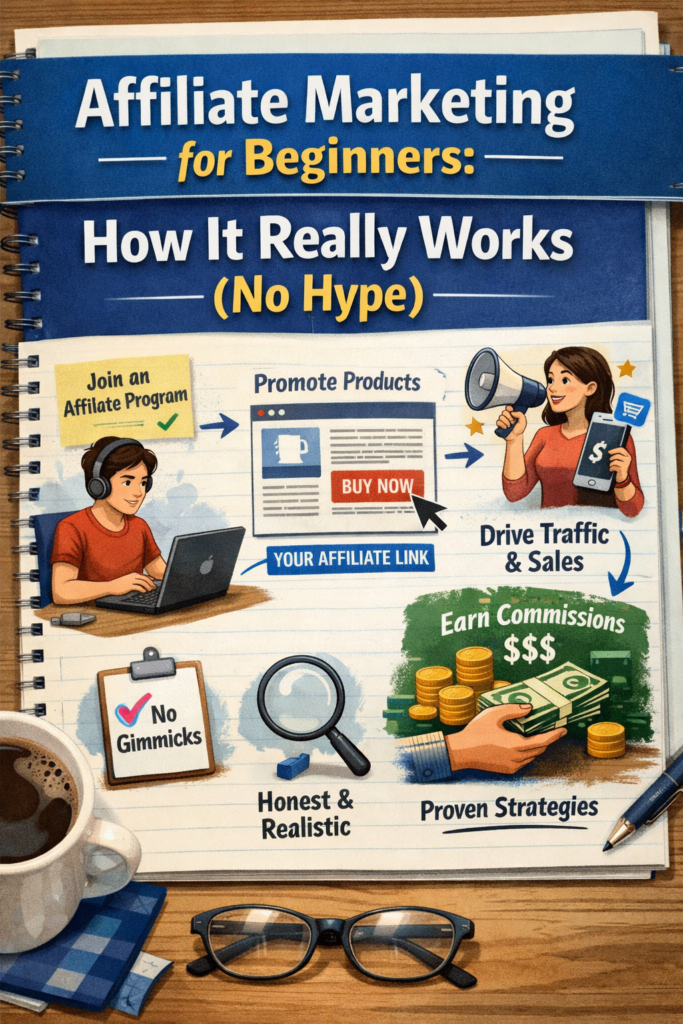
Affiliate marketing sounds simple because it is simple, at least on paper. You recommend something. If someone buys through your link, you earn a commission. That’s it.
What’s not simple is the part nobody sells in ads: trust takes time, traffic takes work, and your first commission might come slower than you want. This guide is for beginners who want extra income now and a real path out of a 9-to-5 later, without pretending it’s quick or guaranteed.
By the end, you’ll understand how affiliate marketing actually works, how people get paid, what to do first, and how to avoid the mistakes that keep most affiliate marketing for beginners stuck at $0.
Affiliate marketing explained in plain English (what it is and what it is not)
Affiliate marketing is a performance-based referral system. A company gives you a special tracking link. You send interested people to that company. If a tracked action happens (often a sale), you get paid.
Think of it like recommending a restaurant to a friend. If the restaurant could track that your recommendation brought them a paying customer, they’d give you a thank-you payment. Affiliate marketing is that idea, just measured with links.
What it isn’t:
- A “magic link” that prints money
- A guaranteed paycheck
- A shortcut around learning basic marketing and communication
- A business where you can ignore customer value and still win long-term
If you want a deeper overview from a mainstream ecommerce source, Shopify’s guide is a solid companion read: affiliate marketing for beginners.
The basic parts: merchant, affiliate, customer, tracking link, commission
Affiliate marketing has a few moving pieces, and once you get them, the whole model stops feeling mysterious.
Merchant (brand): The company selling the product or service (a fitness app, a software tool, hiking gear, a course).
Affiliate (you): The person creating content and sending referral traffic.
Customer: The reader or viewer who clicks and buys (or takes another tracked action).
Tracking link: A special URL that identifies you as the referrer. It usually includes an ID and sometimes extra tags you can set.
Commission: Your payout when the tracked goal happens.
Tracking is usually handled with cookies. A cookie is a small piece of data that tells the merchant, “This person came from this affiliate.” Cookie windows vary. Some are 24 hours, some are 30 days, some are longer. Programs also set rules like payout minimums, approved traffic sources, and how you’re allowed to describe the product.
How you actually get paid (commission types and payout timing)
Affiliate income is not always “a percent of the sale.” Here are common payout styles:
Commission typeWhat it meansWhere you’ll see itPercent of saleYou earn a percentage of what the customer paysPhysical products, many digital productsFlat fee (CPA)You earn a fixed amount per action (sale, trial, lead)Finance tools, apps, lead-gen offersRecurringYou earn monthly as long as the customer staysSoftware, memberships, subscriptions
Payout timing is rarely instant. Many programs wait for the refund period to pass, then pay on a set schedule (often monthly). Some also require you to hit a minimum balance before they send money.
A useful mindset: you don’t always need huge traffic if your offer pays well. A higher-priced product or a recurring subscription can beat dozens of small commissions, even with fewer clicks.
For another plain-language breakdown of the “what and why,” OptinMonster has a clear explainer: Affiliate Marketing: The What, Why and How.
How affiliate marketing really works step by step (from zero to first commission)
Most beginners fail because they try to do everything at once. Ten niches, three platforms, random products, and no plan.
A realistic path is simpler: pick one niche, build helpful content that answers real questions, add affiliate links with care, then improve what’s already working.
Pick a niche with buyers, then pick a clear angle
A niche is the group you help and the problem you focus on. “Fitness” is broad. “Budget home fitness for busy parents” is a niche with an angle.
“Buyers” matter because likes don’t pay bills. You want topics where people already spend money to solve problems.
Beginner-friendly niche examples with buyer intent:
- Budget home fitness (adjustable dumbbells, beginner programs, simple meal prep tools)
- Beginner credit-building tools (secured cards, budgeting apps, credit monitoring)
- Email marketing for small businesses (email platforms, templates, landing page tools)
- Hiking gear for starters (boots, packs, beginner trails, safety basics)
Your angle is your promise. It helps people choose you over 50 similar creators. Good angles are often simple: “for beginners,” “under $100,” “for busy people,” “for small spaces,” “for over 40.”
Choose your platform: blog, YouTube, TikTok, or email first
Each platform can work. The mistake is trying to grow all of them in week one.
Blog (website): Great for reviews, comparisons, and “best X for Y” searches. It can grow slowly but it compounds.
YouTube: Strong for demos, tutorials, and “watch before you buy” content. Trust builds fast when people see you use the product.
TikTok: Fast reach and quick testing. Great for simple tips and short product use-cases, but results can swing.
Email: Not a traffic source by itself, but it keeps you in contact when algorithms change. It also turns one-time visitors into repeat readers.
Start with one main platform. You can add a second channel once you have a small content library and you know what your audience wants.
If you want structured beginner training without hype, Ahrefs offers a free course that focuses on the fundamentals: Affiliate Marketing Course for Beginners.
Join legit affiliate programs and pick products you can stand behind
An affiliate program is a brand’s own referral system. An affiliate network is a marketplace that hosts many programs and handles tracking and payouts.
Common beginner routes include Amazon Associates, ShareASale, Awin, Impact, Shopify’s affiliate program, and creator marketplaces like TikTok Shop (rules vary by region and account).
What to look for before you apply:
Product quality: If it’s junk, refunds will eat your earnings and your reputation.
Clear terms: Read the rules on link placement, email use, coupon use, and brand bidding.
Fair commissions: A low rate can still work with high conversion, but know the math.
Support and assets: Good programs provide dashboards, reporting, and sometimes banners or swipe copy (use as a reference, not as your whole strategy).
If you’re looking for ideas across many industries, Shopify keeps a running list of options: best affiliate programs.
Create content that earns trust (reviews, how-tos, comparisons)
People don’t wake up wanting affiliate links. They wake up wanting answers.
Content that tends to convert well:
“Best for beginners” posts and videos that reduce overwhelm
Comparisons like “X vs Y” that help people choose
How-to guides that show setup and real use
Personal results when you’ve actually tested the product
Mistakes to avoid that save time or money
Honesty beats hype. If a product has a learning curve, say that. If it’s great but pricey, say who it’s for. If you haven’t used it, be clear that you’re sharing research and what users report, then cite sources when you can.
A good rule: aim to be the friend who gives the advice you’d want before spending your own money.
For a broader, beginner-friendly overview of the model and career paths around it, Coursera’s explainer is helpful: What Is Affiliate Marketing and How to Get Started.
Add your affiliate links the right way (placements that convert)
Affiliate links work best when they show up at the moment a reader is ready to act.
High-performing placements include:
- In-text links near the exact recommendation
- A simple comparison table when you’re discussing options
- A clear call-to-action button on review pages (if your platform allows it)
- A YouTube description link under a demo or tutorial
- A pinned comment that points to the same resource (where allowed)
- A “Tools I use” resources page that you update over time
Keep link placement natural. Too many links feels pushy and can hurt clicks.
Also, add a clear disclosure near your first affiliate link. It protects you, and it shows you’re not hiding the ball.
Real expectations, common mistakes, and how to stay legal (no drama)
Affiliate marketing can change your finances, but it usually doesn’t change them overnight. Most people underestimate the time it takes to build content, learn what converts, and earn consistent traffic.
The upside is that the skills you build, writing, video, email, and basic analytics, keep paying you long after the beginner stage.
What beginners usually earn, and what impacts income the most
In the first 6 to 12 months, many beginners earn $0 to a few hundred dollars a month. Some break out faster, but that’s usually tied to consistent publishing, a clear niche, and content that matches what buyers search for.
Income is driven less by “how many followers you have” and more by:
Traffic quality: Are your visitors actually looking to buy or solve a problem?
Offer fit: Does the product match the reader’s situation and budget?
Trust: Do people believe you, based on how you explain and show proof?
Content volume: More helpful pages and videos gives you more chances to be found.
Conversion rate: Small changes to titles, calls to action, and clarity can double results.
One viral post can help, but consistency over months usually wins.
Top beginner mistakes that kill results (and the simple fixes)
Promoting random products: Fix it by choosing 1 to 3 “core” products that match your niche, then build content around real use cases.
Chasing trends every day: Fix it by mixing timeless topics (how-tos, comparisons) with occasional trend posts.
Skipping an email list: Fix it by offering one simple freebie (checklist, quick guide, template) and collecting emails early.
Not tracking clicks and pages: Fix it by checking your affiliate dashboard weekly and noting which pages drive clicks.
Quitting too early: Fix it by committing to a 90-day content run before you judge results.
Relying on one platform forever: Fix it by adding a second channel once you have traction, like turning blog posts into short videos, or turning videos into emails.
Using hypey promises: Fix it by making your content about outcomes and trade-offs, not fantasy numbers.
Disclosures, platform rules, and honest marketing basics
Disclosures are simple: tell people you may earn a commission if they buy through your link. Put it near the first affiliate link, not buried at the bottom. Write it in plain language.
Also follow the program’s rules. Amazon, for example, has strict requirements around link formats and how you describe pricing. Many programs forbid spam, cookie stuffing, fake reviews, or misleading claims.
The long-term asset in affiliate marketing is not your link. It’s your reputation. When readers trust you, they come back, and they buy again.
Your simple 30-day beginner plan (plus join the mailing list for money-making tips)
You don’t need a complex funnel to start. You need a focused month where you publish, learn, and improve.
Week-by-week plan to get your first clicks and leads
Week 1: Set the foundation
Pick one niche and one angle. Join 1 to 2 affiliate programs. Set up your main platform (a simple blog or a single social channel). Create a basic “Start here” page or pinned post.
Week 2: Publish helpful content
Post 2 to 4 pieces of content that answer beginner questions. Focus on clarity, not perfection. Add one affiliate link only where it fits.
Week 3: Add comparison content and a simple lead magnet
Create one “X vs Y” or “best for beginners” piece. Make a one-page checklist as a free download, then add an email signup to collect leads.
Week 4: Review stats and improve
Check what got clicks and what didn’t. Update one piece of content to make it clearer. Add one small second channel, like turning your best post into a short video, or summarizing it in an email.
Join my email list to get beginner-friendly ways to make money online
If you want step-by-step help without tech overload, join the NewbieLesson.com mailing list. You’ll get practical affiliate marketing lessons, traffic ideas you can use as a beginner, and tool reviews that call out scams and fine print.
Subscribe so you can get the next lesson and keep moving while most people stall.
Conclusion
Affiliate marketing is not a trick. It’s a simple deal: recommend the right products to the right people, earn commissions, and build trust with every helpful piece of content.
If you want this to work, keep it boring in the best way. Pick a niche, publish consistently, track what’s getting clicks, and improve one page at a time. Your next step is simple: choose your niche and publish your first helpful post or video today, then join the email list so you don’t have to figure it out alone.

My Name Is Rafael Ferreras. I share practical tips, tools, and resources to help make building income online simpler and more approachable. I am a professional digital marketer with over 14 years of experience in the industry. My expertise is in email marketing and boosting conversions with bridge pages. I write about affiliate marketing and traffic generation.






Pingback: Start Affiliate Marketing the Smart Way in 2026 – Daily Cash For You
Pingback: Affiliate Marketing: High Ticket vs Low Ticket Pay (2026)
Pingback: 10 Legit Work-From-Home Jobs (4th one is amazing!!!)
Pingback: A Practical 12 Month Affiliate Marketing Plan